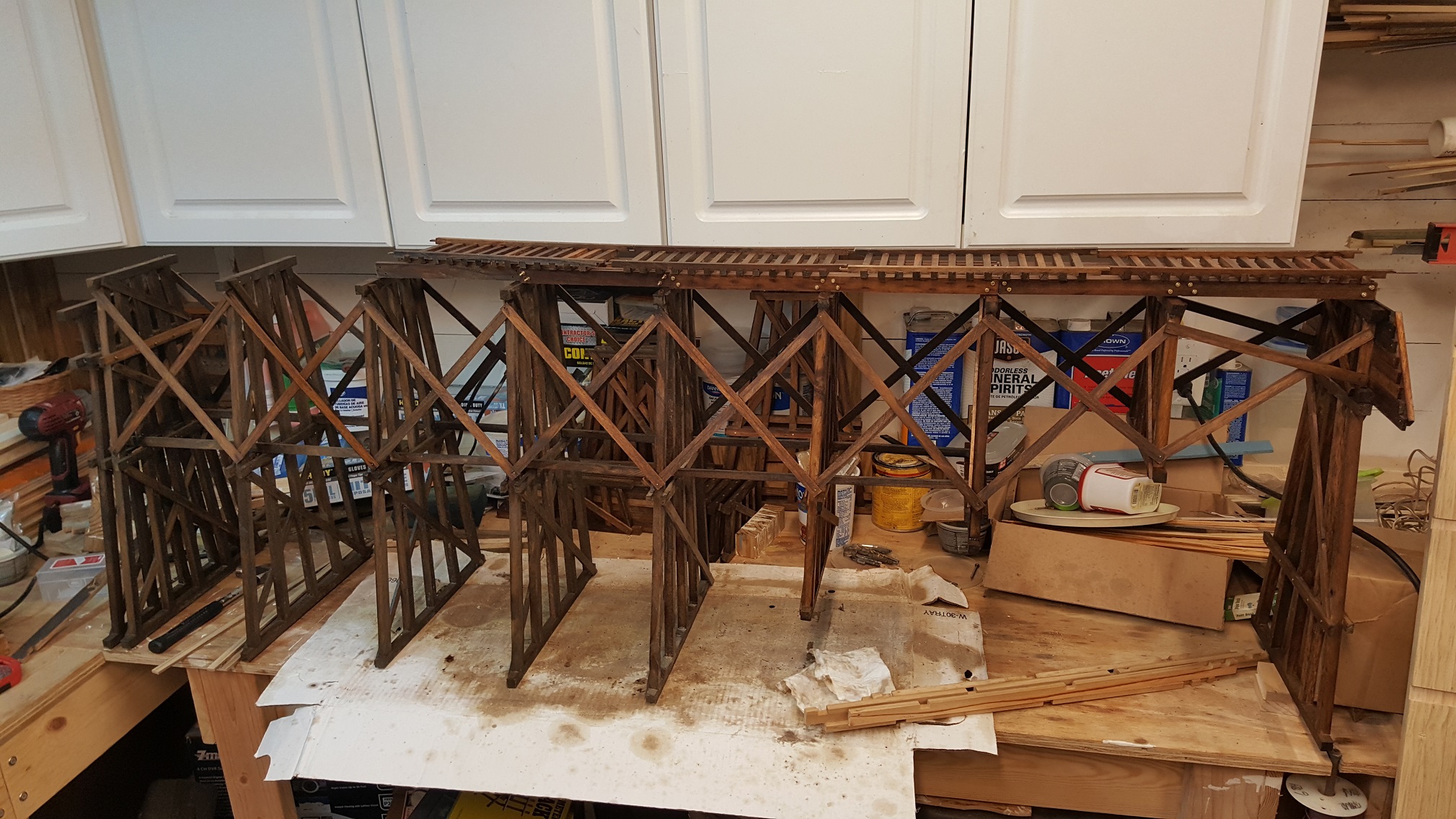
Making Trestle Bents
This was one of the first modelling projects attempted during the first incarnation of the Barkyard. There was plenty of raw material left after replacing the fence between us and the neighbor. Most of it was rotted away, but those parts the were still in good shape got stashed, a euphemism for leaned against the side of the garage until finally pressed into service.
It all started in the living room of our home in Mount Dora, not quite a year after moving here. Using a hastily fashioned "template", if you can even call it that, made from the same ½"x½" stock used for the legs of the trestle bent. After assembling the first few bents, it was readily apparent a different template was necessary. No repeatability, but at least the design works and bents are being built!
Those first few bents were the only ones made for nearly a year after that initial push. There were other, higher priorities, like rewiring the house and running electricity to the garage after adding a plywood floor over the bare dirt. The benches and cabinets came along shortly after that. It certainly explains why things started in the living room.


Lessons learned helped create a new template that allows bents to be built in 1" height increments. It's designed to be "reversible", that is to say, it allows features to be added to one side of the assembly, which can then be removed from the template and flipped over to allow those features to be added to the other side, like crossbracing and such.
Equipped with ribs on the back that engage with the "T" slots on the table saw allows cutting the bent legs to the proper 5° and 10° angles in one pass, rather than having to do them one at a time and all the miter gauge setup that goes with it. They can then be flipped around and cut to exact length with another single pass. That was the major issue with repeatability, all those error prone manual steps.
We'll call it a "jig" since it's more than a template for holding things in place for assembly. Whatever it's called, it speeds assembly and reduces the number of steps required to build a trestle bent. It's an assembly line, with all the parts pre-ripped to size and pre-cut to length. Even though we're cranking out those bents and assembling them into large trestle structures, it all comes to a screeching halt for even more home improvement projects.
Not only did the railroad get put on hold, but everything we'd done so far had to be ripped up and stored yet again! The railroad was put on hold for years! When we finally did bring everything out of mothballs, it was much better than when we first moved here. The third incarnation is truly the Barkyard RR. We were finally able to run trains and enjoy the view! It only took a total transformation of the back yard...


That transformation didn't happen all at once either. Starting out, the arrangement was meant to be a folded dogbone, but quickly became just a dogbone when we ran out of track. After solving that issue, we added a wye and extended the ground level to finish that folded dogbone. It slowly evolved into the track arrangement we have today, adding a deck, then rearranging into the "triple decker" we have now. Perhaps I should say had...
Left out of that equation were multiple stringer replacements and improvements, but time finally took its toll and I was no longer able to keep ahead of all the work needed to keep trains running. Soon going in the wrong direction, I was pulling up sections of track when they became unmanageable and a danger to the pups. But enough history. Let's talk about moving the railroad in the right direction again!
We're are pinning our hopes on two improvements moving forward. The first is casting roadbed "bricks" from concrete to avoid the constant rot of the wooden stringers. We cover that elsewhere. The big improvement we'll discuss here is replacing the deteriorating upper loop stringers with a new trestle from the side of the deck around to the bridges, one over the planned water feature, and the other over the tracks below, the triple decker.
From past experience, just trying to arrange three trestle bents into an approach trestle proved to be a chore, another one of those "need three hands" adventures. Now add the extra complications of arranging them together at an angle to each other for curves and staircasing taller and taller at the same time and it's time for a jig designed to fit the job at hand.